

Quick answer: For most legal documents mailed flat, use a 9x12 envelope for standard letter-size papers or a 10x13 envelope for thicker packets and legal-size 8.5x14 sheets. Use peel-and-seal for a tamper-evident, moisture-free seal. Choose Tyvek for irreplaceable originals that cannot be damaged in transit. Use a clasp envelope for internal office routing. Add a security tinted interior for any correspondence with confidential client information. No minimum order. Free ground shipping on every order at Business Envelopes.
Mailing a legal document is not the same as mailing an office letter. A contract that arrives creased, a deed that gets wet and tears, a closing packet where the flap lifted open in transit: each of these creates a real problem before the recipient reads a word. The envelope you choose determines whether the contents arrive in professional condition or become a problem to fix.
This guide covers every decision a law firm, title company, paralegal, notary, or business professional needs to make: size, fold versus flat, seal type, security tinting, what to write on the outside, certified versus registered mail, and USPS postage rules for 2026. Every product linked here is available with no minimum order and free ground shipping from Business Envelopes, a commercial envelope supplier serving US businesses and legal offices since 1997.
Can I Mail Legal Documents in a Regular Envelope?
You can, but the answer depends entirely on what the document is. A single-page client letter folded in thirds and sent in a standard #10 envelope is perfectly acceptable for routine correspondence. An original signed contract folded into a #10 is a professional presentation problem that creates permanent crease marks across the face of the document.
The practical rule most law offices follow: if the document is routine and informational, a #10 is fine. If the document is a contract, deed, discovery response, court filing, signed original, or anything that will be filed, scanned, recorded, or presented to another party, mail it flat. A flat envelope always reads as more intentional and professional, and it eliminates any risk of document damage from the folding process.
What Size Envelope Do I Need for Legal Documents?
| Document Type | Paper Size | Right Envelope | Why |
|---|---|---|---|
| Single contract / letter (flat) | 8.5 x 11 | 9x12 | Holds letter-size paper flat, no folding |
| Thick packet, multiple pages (flat) | 8.5 x 11, multi-page | 10x13 | Extra room for stacked pages, exhibits, and attachments |
| Legal-size document (flat) | 8.5 x 14 | 10x13 or 10x15 | Legal paper fits flat; no length trimming needed |
| Closing package / deed packet | Mixed sizes | 10x13 or 10x15 | Room for tabbed packets, inserts, and thick stacks |
| Routine single-page letter (folded) | 8.5 x 11 | #10 commercial | Standard business letter; folding acceptable for single page routine notices |
| Irreplaceable signed original | Any | Tyvek 10x13 or 10x15 | Tear-proof, moisture-resistant; arrives intact |
| Internal office routing | Any | Clasp 10x13 or 10x15 | Reusable; routes without sealing the gum flap |
A Note on the #14 Envelope for Folded Legal-Size Paper
If your practice regularly mails on 8.5x14 legal-size letterhead and folds it for mailing rather than sending it flat, the #14 commercial envelope (5 x 11.5 inches) is the correct folded-format choice. The #14 fits legal paper folded in half lengthwise and qualifies for First-Class letter postage at $0.82 per ounce in 2026, making it more economical than flat-rate postage when document volume is low. However, if the legal packet is thick, multi-page, or must arrive unfolded for scanning or filing, the 10x13 flat envelope is still the better choice. For the #14 with a window for address efficiency, see the Legal Size Window Envelope: #14 Guide and Uses.
Should I Fold Legal Documents or Mail Them Flat?
This is the question notaries, paralegals, and small business owners search for most often. The answer is simple in practice: when in doubt, mail flat. Flat mailing is always more professional. It arrives crisper, signals the significance of the contents, and eliminates any scanning, filing, or presentation issues caused by fold marks.
The only situation where folding is clearly acceptable is a single-page routine notice, billing letter, or informational correspondence that will be read and discarded. Anything that will be filed, recorded, countersigned, or retained belongs in a flat envelope.
How to Decide: Fold or Flat in Five Steps
- Identify the document type. Is this a contract, deed, signed original, court filing, or discovery packet? If yes, skip to step 3. If this is a routine client letter or single-page notice, continue to step 2.
- For routine letters: fold in thirds and use a #10. A single-page letter on 8.5x11 paper can be folded in thirds and mailed in a standard #10 envelope. This is appropriate for notices, billing letters, and single-page correspondence. Skip to step 5.
- For important documents: choose flat mailing. Contracts, deeds, signed originals, multi-page filings, discovery packets, and anything that must arrive uncreased should go into a 9x12 or 10x13 flat envelope. Flat mailing is always the more professional presentation for legal correspondence.
- Choose the right flat envelope size. Use a 9x12 for standard 8.5x11 documents up to a quarter inch thick. Use a 10x13 for thicker packets, legal-size 8.5x14 documents, or closing packages. Use a 10x15 for oversized or very thick document stacks.
- Mark and seal the envelope. Write or stamp CONFIDENTIAL if the contents are sensitive. Stamp DO NOT BEND if the contents are rigid or particularly sensitive to creasing. Seal with peel-and-seal for a tamper-evident closure that shows the recipient if the piece was opened in transit.
9x12 Envelopes: The Standard Flat Format for Legal Correspondence
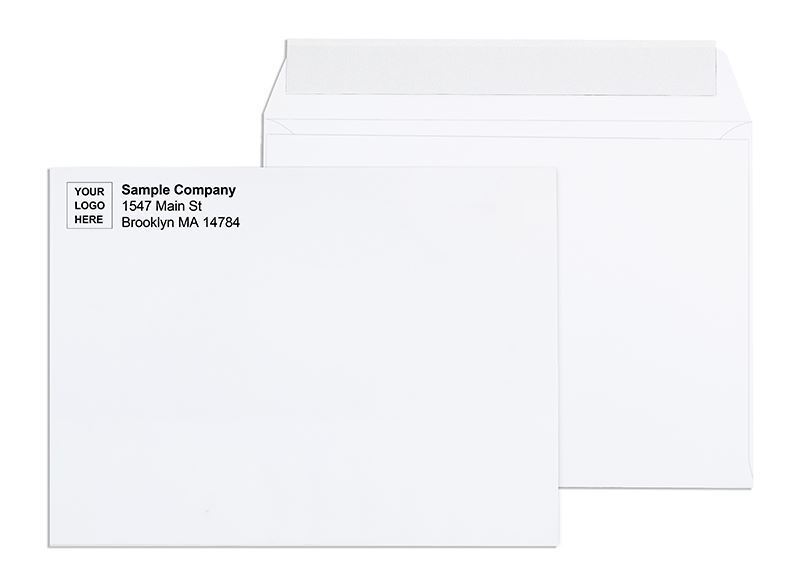
The 9x12 envelope is the standard flat-mailing format for most law offices, title companies, and legal professionals. It holds a standard 8.5x11 sheet or a thin packet of letter-size papers with a quarter-inch clearance on each dimension. That clearance is enough to load documents cleanly without forcing or overstuffing the envelope.
The 9x12 white booklet peel-and-seal envelope opens on the long side, which is the correct orientation for loading a flat letter-size document. At 28 lb bond paper, the wall is heavier and more opaque than a standard envelope, providing both a professional presentation and better protection for the contents during handling. The peel-and-seal closure produces a tamper-evident bond with no moisture required.
When to Use a 9x12 for Legal Documents
- Contracts and agreements that must arrive flat and uncreased
- Certificates of insurance, notarized documents, and signed forms
- Client correspondence from law firms, title companies, and real estate offices
- Court filings mailed to opposing counsel or co-parties (not filed with the clerk, which has specific requirements)
- Tax return packets and IRS correspondence
- Multi-page discovery packets up to about a quarter inch thick
- Any mailing where the professional presentation of the document matters
Explore the full 9x12 range at 9 x 12 Envelopes. For a full breakdown of formats, see the 9x12 Envelope: Size, Uses, Formats, and When to Use It.
10x13 Envelopes: For Thicker Packets and Legal-Size Paper

Use the 10x13 when the 9x12 is too tight. Thick multi-page documents, tabbed closing packets, legal-size 8.5x14 sheets mailed flat, or any packet with inserts and attachments goes into a 10x13. The extra inch on each dimension makes loading faster and ensures the flap closes cleanly without straining at the seal.
The 10x13 white open-end peel-and-seal envelope opens at the short end, which is the standard catalog orientation for flat document mailings. It handles both single packets and stacked multi-document packages. The 28 lb paper weight provides enough wall opacity that contents do not show through when held to light. Explore the full 10x13 range at 10 x 13 Envelopes.
When to Use a 10x13 for Legal Documents
- Closing packages from real estate attorneys and title companies with deeds, settlement statements, and recorded documents
- Multi-page contracts with exhibits, appendices, or numbered attachments
- Legal-size documents (8.5 x 14 inches) that must arrive flat
- Court-related mailings where the document stack exceeds what a 9x12 can close cleanly
- Mixed packets with both letter-size and legal-size pages
- Corporate governance documents, board resolutions, and shareholder agreements
For a complete breakdown of large flat document formats and size comparisons, see Large Envelope Sizes: 9x12, 10x13, and More Explained.
Tyvek Envelopes: For Irreplaceable Legal Originals

Most legal documents can be reprinted if the original is lost or damaged. Some cannot. An original signed contract with wet ink signatures. An original will. A recorded deed. A certified copy of a court order. If any of these are damaged in transit, the legal, financial, and operational cost to remedy the situation is significant.
Tyvek is made from high-density polyethylene fibers, not paper. It does not tear under postal handling stress. It does not soften or delaminate when wet. When a delivery vehicle sits in rain or a package is left on a step in weather, the document inside a Tyvek envelope stays dry and intact.
The 10x13 Tyvek envelope with Kwik-Tak peel-and-seal closure bonds without moisture and holds through postal sorting. For oversized packages, the 10x15 Tyvek envelope provides the additional room for thick stacked originals. For the complete Tyvek guide, see Tyvek Envelopes: Tear-Proof and Waterproof Mailing Guide.
When to Use Tyvek for Legal Documents
- Signed originals with wet ink signatures where all parties cannot easily reassemble to re-execute
- Original wills, trusts, and estate planning documents
- Recorded deeds and title documents returned to clients after county or municipal recording
- Certified copies of court orders and judgments
- Documents with raised or embossed government seals
- Any mailing where document damage in transit would trigger a legal or operational problem
- Documents traveling long distances, through uncertain delivery conditions, or at times of year with wet weather risk
Browse the full Tyvek range at Tyvek Envelopes.
Clasp Envelopes: For Internal Routing of Legal Files

Before a legal document goes out by mail, it often moves through multiple hands inside the office. A draft goes to the reviewing attorney. A signed document goes to the paralegal for packaging. A recorded deed comes back from the county office and goes to the file before delivery to the client. Using a gum flap envelope for that internal circulation either wastes the envelope by sealing it prematurely or leaves the document unprotected.
A clasp envelope solves both problems. The metal clasp opens and closes repeatedly without activating the gum adhesive. The document routes from desk to desk, the clasp holds it shut, and the gum flap stays intact for the eventual outgoing mailing. The 10x13 brown kraft clasp envelope is the standard for internal legal document routing. The brown kraft exterior is deliberately nondescript, keeping attention off the contents during internal handling. For oversized routing, the 10x15 brown kraft clasp envelope handles thicker document stacks.
Browse the full clasp range at Heavyweight Brown Clasp Envelopes.
What Seal Type Should I Use for Legal Document Envelopes?
Seal type determines two things for legal mail: operational reliability and tamper evidence. An envelope that arrives with the flap visibly lifted creates an immediate concern for the recipient, regardless of whether the contents were actually disturbed.
| Situation | Seal Type | Why |
|---|---|---|
| Hand-sealed outgoing legal mail | Peel-and-seal | Tamper-evident, moisture-free, reliable bond every time |
| High-volume inserter machine program | Gum flap | Required for automated sealing units; peel-and-seal cannot be machine-sealed |
| Internal office routing | Metal clasp only | Reusable; gum flap preserved for outgoing mailing |
| Irreplaceable originals in Tyvek | Kwik-Tak peel-and-seal | Pressure-sensitive bond, moisture-free, tamper-visible if opened |
Should I Use a Security Tinted Envelope for Legal Documents?
Yes, when the contents include anything a client or counterparty would consider private. Legal correspondence routinely contains client names, case numbers, financial details, settlement amounts, personal identifying information, and proprietary business terms. A plain white envelope, held to light under certain conditions, can allow portions of that information to show through the paper wall.
Security tinted envelopes have a patterned interior print that blocks the view of contents when held to light. The pattern runs across the entire interior surface. For billing correspondence, client engagement letters, financial disclosure documents, and any piece that falls under the attorney's ethical obligation to protect client confidentiality, security tinting is the correct specification.
For the complete guide to security tinted formats and their applications in legal and professional settings, see Security Envelopes for Business: The Complete Guide and Security Tinted Envelopes: What They Are and When to Use.
What Should I Write on the Outside of a Legal Document Envelope?
This question comes up repeatedly in paralegal and notary forums. Here is what actually matters and what is optional.
CONFIDENTIAL marking
Writing CONFIDENTIAL or ATTORNEY-CLIENT PRIVILEGED on the outer envelope is not legally required, but it is standard practice for sensitive legal correspondence at most law firms. It signals to postal handlers, mail room staff, and the recipient's office that the piece should be routed directly to the named party. For any correspondence you would consider privileged or sensitive, the marking takes two seconds and provides a meaningful signal. Some attorneys make it standard on every outgoing piece containing client information.
DO NOT BEND marking
Stamping or writing DO NOT BEND on a flat document envelope is not a USPS requirement, but it provides a practical signal when the contents should not be flexed. USPS automated sorting equipment handles flat envelopes with some mechanical pressure. For documents that are particularly sensitive to any bending, such as original certificates with embossed seals or documents being sent to be recorded, stamp DO NOT BEND on both the front and back of the envelope. For maximum protection against bending and tearing, pair the marking with a Tyvek envelope rather than a standard paper one.
Return address and recipient address
Printing the return address and recipient address is always preferable to handwriting for professional legal correspondence. Printed addresses reduce delivery errors, process more reliably through postal scanning equipment, and present more professionally to the recipient. If you are sending high volume, custom-printed envelopes with your return address pre-printed eliminate the labeling step and keep every outgoing piece consistent.
Certified Mail vs Registered Mail: What Is the Difference for Legal Documents?
Both certified mail and registered mail provide proof of delivery and are appropriate for legal correspondence, but they serve different purposes and carry different levels of security.
| Feature | Certified Mail | Registered Mail |
|---|---|---|
| Proof of mailing | Yes. PS Form 3800 receipt provided at time of mailing | Yes. Receipt provided at time of mailing |
| Delivery confirmation | Electronic or physical green card (PS Form 3811) with recipient signature | Electronic or physical green card with recipient signature |
| Chain of custody | Not documented at each transfer point | Full chain-of-custody documentation at every USPS facility and transfer |
| Security handling | Standard postal handling | Secured, sealed containers at every stage; signed receipts at every transfer |
| Best use | Demand letters, legal notices, most court-related correspondence, service of process where allowed | Irreplaceable originals, high-value negotiable instruments, documents requiring legally significant chain of custody |
| Envelope format | Same 9x12 or 10x13 flat envelope; PS Form 3800 attached to outside | Same 9x12 or 10x13 flat envelope; Registered Mail labels applied at post office |
For most legal correspondence including service of process, demand letters, and routine notices, certified mail is sufficient. Registered mail is reserved for situations where the chain of custody documentation at every point of transit is legally significant, or where the document has a high intrinsic or replacement value. The envelope format does not change for either service. For USPS mailing requirements by document type, see Mailing and Sending Letters: The Complete US Business Guide.
USPS Postage for Legal Document Envelopes in 2026
Most flat document envelopes mail as First-Class flats because their dimensions exceed the USPS letter-size threshold of 6.125 x 11.5 inches. A 9x12, 10x13, or 10x15 is always a flat regardless of weight. Only the smaller #10, #11, #12, and #14 commercial formats can qualify for letter rate.
| Envelope | USPS Class | 2026 Rate (1 oz) | Additional oz | Notes |
|---|---|---|---|---|
| #10 (folded single page) | First-Class Letter | $0.82 | +$0.27 | Routine letters folded in thirds; not for flat document mailings |
| #14 (folded legal paper) | First-Class Letter | $0.82 | +$0.27 | Fits 8.5x14 paper folded; letter rate when under 0.25 in. thick and flexible |
| 9x12 (flat) | First-Class Flat | $1.63 | +$0.27 | Thin single sheets may qualify for letter rate; confirm flexibility and thickness first |
| 10x13 (flat) | First-Class Flat | $1.63 | +$0.27 | Standard for multi-page legal packets; always flat rate |
| 10x15 (flat) | First-Class Flat | $1.63 | +$0.27 | Thick closing packets exceeding 10x13 capacity |
Who Uses Envelopes for Legal Documents
Law Firms and Solo Practitioners
Law firms mail contracts, demand letters, settlement agreements, engagement letters, and client updates. Standard outgoing legal mail uses a 9x12 or 10x13 peel-and-seal with security tinting for client-facing correspondence. Internal document routing between attorneys and paralegals uses clasp envelopes. For signed originals, Tyvek provides protection that a paper envelope cannot match. Custom printed envelopes with the firm's name, address, and logo on every outgoing piece signal professionalism consistently across every case.
Title Companies and Real Estate Attorneys
Title companies and real estate attorneys mail closing packages, recorded deeds, title commitments, and survey documents to buyers, sellers, and lenders after every transaction closes. A closing package often includes 10 to 30 pages across multiple document types. The 10x13 is the standard outgoing format. For recorded originals going back to clients after county recording, Tyvek provides the protection that recorded documents require. For the full guide to real estate mailing formats, see Envelopes for Real Estate Agents: The Complete Guide.
Corporate Legal and Compliance Teams
Corporate legal departments mail shareholder agreements, board resolutions, compliance notices, and regulatory correspondence. These typically go out in 9x12 or 10x13 peel-and-seal envelopes with security tinting. For high-volume outgoing legal mail from a compliance or general counsel team, standardizing on a printed envelope with logo and return address maintains brand consistency and chain of custody documentation for every outgoing piece.
Notaries Public
Notaries mail notarized documents to clients and counterparties, often working with mixed-size packets. The 10x13 handles most signing packages flat. For certified or original notarizations that must arrive intact, Tyvek is the protective choice. For loan signings where the packet includes both letter and legal-size pages, a 10x13 accommodates the full packet in a single envelope.
Court Clerks and Government Offices
Court clerks mail certified copies of filings, judgments, and orders. The 9x12 or 10x13 flat envelope is standard for these programs. Government offices mailing on legal-size letterhead use the #14 for routine correspondence or a 10x13 for unfolded certified copies.
Common Mistakes When Mailing Legal Documents
- Using a #10 for documents that must arrive flat. A contract folded in thirds arrives with permanent crease marks. For anything that will be filed, scanned, countersigned, or presented, use a 9x12 or 10x13 flat envelope.
- Using a paper envelope for irreplaceable originals. Paper softens when wet and tears under mechanical stress. For signed originals, recorded documents, and documents that cannot be recreated, use Tyvek.
- Sealing a clasp envelope during internal routing. Once the gum flap is sealed, the envelope cannot be reused without tearing. For internal circulation, use only the metal clasp. Keep the gum flap intact for the outgoing mailing.
- Skipping security tinting for sensitive correspondence. A plain white envelope held to light can expose content. For any legal mail with client-identifiable or financial information, use a security tinted format.
- Assuming a 9x12 always mails at letter rate. A 9x12 is a flat by USPS classification. Letter rate applies only when the piece is thin, flexible, and under 0.25 inches thick. Multi-page packets should be budgeted at the $1.63 flat rate.
- Using peel-and-seal in an inserter machine program. Inserter sealing units require gum flap envelopes. Peel-and-seal cannot be machine-sealed. Confirm which closure your inserter requires before ordering.
- Ordering a size that does not fit legal-size paper. For 8.5x14 legal paper mailed flat, the minimum is a 10x13. A 9x12 is 3 inches shorter than the paper and will not work as a flat mailer for legal-size documents.
- Not retaining a copy of the mailing receipt. For certified or registered mail, keep a copy of the PS Form 3800 receipt and the tracking number in the case file. This is the proof of mailing if the delivery is ever disputed.
What Customers Say
★★★★★ Baila Verified Buyer | 9x12 White Booklet Peel-and-Seal Envelopes
"These are so useful! I personally use them to pack my tax return docs. Perfect for mailing a variety of big documents."
★★★★★ Shaindy Verified Buyer | 10x13 Tyvek Envelopes Peel and Seal
"I love these for mailing brochure packages out to our clients. They get to their destination looking good and staying intact. I used to use regular envelopes and they would arrive with a tear or worse."
★★★★★ Malky Verified Buyer | 10x13 Brown Kraft Clasp Envelopes
"I run a small business and these are perfect! The envelopes are bigger than standard paper and can hold quite a bit. I use these with my employees who weekly scan all receipts."